Saturday, 7 December 2013

Does "Democracy" really exist?

An agnostic's view of the democracy cult.
  
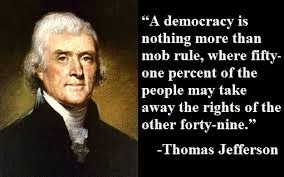
Democracy is the greatest trick the elites ever played on the masses.

 
For instance, the president of the United States must, of course, listen to the people. But you can also rest assured that he answers to Wall Street bankers, oil merchants, the military industrial complex, powerful  lobbyists and others who are, basically, elites.

Friday, 6 December 2013

Russell on Christian Other Worldliness

Mangrove Centre's photo.
Mangrove Centre's photo."Christianity offers reasons for not fearing death or the universe, and in so doing it fails to teach adequately the virtue of courage. The craving for religious faith being largely an outcome of fear, the advocates of faith tend to think that certain kinds of fear are not to be deprecated. In this, to my mind, they are gravely mistaken. To allow oneself to entertain pleasant beliefs as a means of avoiding fear is not to live in the best way.


In so far as religion makes its appeal to fear, it is lowering to human dignity."

-Bertrand Russell "Education and the Social Order" (1932) p. 107

Tuesday, 3 December 2013

What Makes Us Human? Doing Pointless Things for Fun

What Makes Us Human? Doing Pointless Things for Fun

Playfulness is what makes us human. 
Doing pointless, purposeless things, just for fun. Doing things for the sheer devilment of it. Being silly for the sake of being silly. Larking around. Taking pleasure in activities that do not advantage us and have nothing to do with our survival. These are the highest signs of intelligence.

The great German philosopher Friedrich Nietzsche said this: “one must still have chaos in oneself to be able to give birth to a dancing star.” It is the chaos in ourselves that is divine. We can be trained to do almost anything, harnessed to almost any purpose. But there remains a wayward spark whose unpredictability lies in the fact that it is pointless. That is humanity.


In playfulness lies the highest expression of the human spirit.

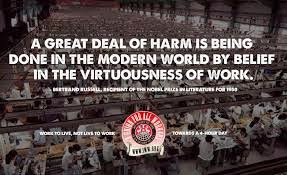
Time for us to uphold the virtue of idleness, to play down the demands for productivity.


Albert Camus November 7, 2013 marked the 100th anniversary of Camus's birth.

Mangrove Centre's photo.“To lose one's life is no great matter; when the time comes I'll have the courage to lose mine. But what's intolerable is to see one's life being drained of meaning, to be told there's no reason for existing. A man can't live without some reason for living.”
― Albert Camus, Caligula

November 7, 2013 marked the 100th anniversary of Camus's birth.

“The most loathsome materialism is not the kind people usually think of, but the sort that attempts to let dead ideas pass for living realities, diverting into sterile myths the stubborn and lucid attention we give to what we have within us that must forever die.”
― Albert Camus, Lyrical and Critical Essays

“Every act of rebellion expresses a nostalgia for innocence and an appeal to the essence of being.”
― Albert Camus, The Rebel: An Essay on Man in Revolt

“To create today is to create dangerously. Any publication is an act, and that act exposes one to the passions of an age that forgives nothing.”
― Albert Camus, Resistance, Rebellion and Death: Essays

Monday, 25 November 2013

Philosophers' Madness: Thin line separates Genius and Insane

Her battle to survive schizophrenia: The top student who landed in a mental hospital  
 
a former Raffles Girls' Secondary School (RGS) student with a master's degree in philosophy from the London School of Economics. At the time of her arrest, she was a philosophy research scholar at the National University of Singapore (NUS).
The day after her arrest, she was admitted to the Institute of Mental Health where she was diagnosed with schizophrenia.
- See more at: http://yourhealth.asiaone.com/content/top-student-who-landed-mental-hospital/page/0/0#.dpuf


"In philosophy, philosophical problems are often taken to their logical extremes. In madness, real-life issues are taken to their logical consequences and acted upon. So is madness simply an extension of philosophical reasoning? And if so, could it be that philosophy and madness are somehow inextricably linked?" 


Miss Chan Lishan,  a former Raffles Girls' Secondary School (RGS) student with a master's degree in philosophy from the London School of Economics, was a philosophy research scholar at the National University of Singapore (NUS).


Read more at her blog: http://lishanchan.wordpress.com/2012/01/16/philosophy-of-madness/

Many famous and brilliant thinkers have been diagnosed with schizophrenia or a form of mental illness. Here's a list:

Vincent van Gogh = Artist
John Nash = Mathematician
Eduard Einstein = Son of Albert Einstein
Friedrich Nietzsche = Philosopher
Soren Kierkegaard = Philosopher
Michel Foucault = Philosopher
Ludwig van Beethoven = Composer and Musician
Leo Tolstoy = Novelist
Winston Churchill = Prime Minister of England during WW2

Eugene O'Neill = Nobel Prize-winning playwright
Ernest Hemingway =  Novelist winner of Pulitzer Prize and a Nobel Prize
Judy Collins = Singer and songwriter
Dorothy Hamill = 1976 Olympic figure skating champion


Those who ask the difficult questions, like “Why are we here?”, “From where do we derive morals?” and “What does it all really mean, when you get right down to it?” have given humanity amazing philosophical insights and ethical guidance. Unfortunately, thinking too much about these issues can sometimes also lead to the brains of those philosophizing rejecting the difficulty — feeling the pressure just a little too much! Then again, maybe it’s a wee bit of madness that leads great philosophers to try to seek out the answers in the first place.

Some people who are diagnosed with mental disorders, such as bipolar disorder, often have delusional thoughts or start to think too much about the meaning of life and why they personally are here on earth. It appears that people with diagnosed mental disorders often delve into the field of philosophy, which pulls together the fields of mental health and philosophy even more. (www.philo-sophia.net)


Read more at http://plato.stanford.edu/entries/mental-illness/

"In philosophy, philosophical problems are often taken to their logical extremes. In madness, real-life issues are taken to their logical consequences and acted upon. So is madness simply an extension of philosophical reasoning? And if so, could it be that philosophy and madness are somehow inextricably linked?" - See more at: http://yourhealth.asiaone.com/content/top-student-who-landed-mental-hospital/page/0/1#sthash.wtEqwA3J.dpuf

Saturday, 23 November 2013

Civil Disobedience: People power cuts both ways

People power cuts both ways
Thais Protest

"Despite being a democratic means of expression, street gatherings can also be used to achieve undemocratic goals, scholars have warned as Thailand sees a surge in political protests."


Riot Police Ready to Act


Gandhi Non-Violent March
"Non-violent disobedience such as peaceful strikes, or wearing signs or symbols to protest for a long time have also brought about the same or more powerful impacts than street gatherings."

But. For how long before more aggressive actions are needed?   
Even no-violence protests harm the country's economics. Inevitable casualties and lives will suffer as a result. All forms of action have consequences. 
We need to pay a price for change.


Father of Non-Violence Protest
"Protest organisers (should) consider different approaches such as making events more like festivals or carnivals instead of inciting anger or hatred against others."

Too idealistic and romantic. Carnivals are more suited for celebrations, not protests.  

When people have been treated unjustly, they are angry.  Angry enough to take to the streets. 

It's belittling to ask them to have fun. 

When demands for change meet resistance,
friction sparks explode. 

Only a strong fire can melt injustice's iron chains.


"Civil disobedience works if they involve and engage with grassroots or community people for some time."

Agree.  Mobilise the people!

Let a thousand, no, a million flowers bloom.  Then her landscape will change.
-- A response to Janjira Sombatpoonsiri, a political science lecturer at Thammasat University during a seminar at Chulalongkorn University.

Friday, 15 November 2013

Must We Mean What We Say?: On Stanley Cavell


Must We Mean What We Say?: On Stanley Cavell
Stanley Cavell, born in 1926 and now 86 years old, is one of the greatest American philosophers of the past half-century. He was also something of a musical prodigy and like many prodigies his accomplishments struck him as a matter of fraud.

Cavell’s response to all of logical positivism: to demand that we only speak about what is absolutely true and false, that about that which we cannot speak with certainty, we must be silent, is to demand that we not speak at all—or else that we lie to ourselves about the ambiguity inherent in even the most carefully defined language.

Cavell’s larger argument is this: If we must bring the world with us to understand a definition, then we cannot define away the ambiguity in words, for the world we bring with us is already hopelessly ambiguous. 

A philosopher who limits the meaning of her words to carefully set out definitions, attempting to root out all ambiguity, in effect says, “I say, and you should hear, only what I mean.”

Cavell insists that language cannot be limited in this way. Language, to Cavell, is ambiguous not because it is imperfect, awaiting precise definition, but because we do not all see in the same way; it is a reflection of our basic predicament as distinct human beings. Thus, we must dare to mean what we say, take responsibility for all the meanings our words might be taken to have—even if those meanings go beyond what we understand as our intentions—because in our unintentional (though perhaps meaningful) slips, and the misapprehensions, mistakes, and insights of those with whom we speak, we bring together not just words but worldviews. 

 More striking, Cavell finds in classic Hollywood comedies like The Awful Truth, The Philadelphia Story and Adam’s Rib (discussed in Pursuits of Happiness [1981]) perhaps the best available examples of how to actually deal with skepticism.

Given the rise of writers like Slavoj Zizek such claims about the importance of film to philosophy may seem unoriginal. But Cavell was among the first philosophers to take film seriously (his half-crazed 1971 book The World Viewed partly founded the philosophy of film), and he has set an example that others might more profitably follow.

Cavell found in Emerson and Thoreau the idea not of the “best self,” which we always look up at from below, but of what he calls, somewhat jocularly, the “next self”—the self we cannot help but see from wherever we happen to be standing. Whether more ordinary or extraordinary than ourselves at present, this self draws us on, makes us skeptical of our current selves, ashamed of them, as if we were nothing but frauds.

“The worst thing we could do is rely on ourselves as we stand,” Cavell writes, channeling Emerson.

“We must become averse to this conformity, which means convert from it,. . . .as if we are to be born (again).” And the self we are born into is, obviously, not in any sense our “best self”; it is by no means final; it is only our “next self.”

As Emerson himself puts it: “Our life is an apprenticeship to the truth, that around every circle another can be drawn; that there is no end in nature, but every end is a beginning.”